Top 5 WhatsApp Business API Platforms for Ecommerce Stores Who Need Smart Chatbots
Your WhatsApp inbox is full of order questions your team answers by hand. Some platforms charge more the moment you add a chatbot or a second agent, so stores start hunting for alternatives. This guide gives you five platforms worth comparing. For a closer look at the options in this space, see Com.bot.
You will learn what actually separates them: smart chatbot builders, ecommerce integrations, pricing, and setup speed. Then you get a clear breakdown of each option and a top pick, so you can decide which WhatsApp Business API platform fits your store.
What Ecommerce Stores Should Look For in a WhatsApp Business API Platform
Choosing a WhatsApp Business API platform for your ecommerce store requires evaluating several critical factors that directly impact customer experience and operational efficiency. WhatsApp has become a cornerstone of conversational commerce, and for good reason. Messages sent through the channel see exceptionally high open rates, and shoppers who engage with a brand on WhatsApp tend to click through and act at far higher rates than they do with traditional email campaigns. Our breakdown of Is the Stock Market Open on Juneteenth covers the related details.
That performance gap matters because ecommerce runs on timely, personal communication. A customer asking about a product size, a delivery window, or a return policy expects an answer within minutes, not hours. A WhatsApp Business API platform, delivered through a WhatsApp Business Solution Provider, gives stores the infrastructure to meet that expectation at scale.
Not every platform handles this well, though. Some focus on broadcast messaging alone. Others offer deep chatbot logic but weak store connections. The right fit depends on your catalog size, order volume, and support team.
This guide evaluates platforms against five criteria that separate a genuinely useful tool from one that adds friction:
- Smart chatbot capabilities, including natural language understanding and no-code builders
- Ecommerce integrations with your storefront and CRM
- Pricing structure and total cost of ownership
- Setup speed, whether you launch in days or weeks
- Support quality, especially for time-sensitive customer queries
Each factor compounds the others. A powerful chatbot is wasted if it cannot read your order data. Low pricing means little if setup drags on for weeks. The sections below break down what to look for in each area so you can compare platforms on equal footing.
Smart Chatbot Capabilities and Ecommerce Integrations
A platform's chatbot must go beyond basic auto-replies to handle complex ecommerce tasks like product recommendations and order tracking. The difference between a frustrating bot and a helpful one usually comes down to natural language understanding. Shoppers type messy, informal queries. A capable bot interprets intent rather than matching exact keywords.
Look for a no-code chatbot builder if your team lacks developers. Drag-and-drop flow editors let marketing and support staff update conversation paths without engineering tickets. That agility matters during peak seasons when product lines and policies shift quickly.
Core tasks a smart chatbot should manage include:
- Product queries, answering sizing, availability, and specification questions
- Cart abandonment recovery, following up with shoppers who left items behind
- Order tracking, pulling live status from your order system
- Personalized shopping, recommending items based on browsing or purchase history
- Lead generation, capturing contact details for follow-up campaigns
Integrations determine how much of this actually works. A chatbot is only as smart as the data it can reach. Essential connections include Shopify, WooCommerce, Magento, and BigCommerce, plus your CRM for unified customer profiles. Catalog integration lets the bot pull live product details and pricing. Payment links and checkout automation shorten the path from conversation to completed sale.
Interactive buttons, quick replies, and rich media keep conversations efficient and on-brand. Template messages handle re-engagement outside the 24-hour service window. When these pieces work together, stores typically see higher conversion on chat-assisted journeys and a lighter load on human support agents.
Pricing, Setup Speed, and Support
Pricing models for WhatsApp API platforms vary widely, from flat monthly fees to usage-based tiers, so understanding total cost of ownership is crucial. A low headline price can hide per-message fees, charges for additional agent seats, or add-ons for features you assumed were included.
Common structures you will encounter include monthly subscriptions, quarterly plans with modest discounts, and usage-based billing tied to conversation volume. Meta charges its own fees for conversations, which sit on top of whatever the platform charges. Ask each vendor to clarify what is bundled and what is metered.
Watch for these potential hidden costs:
- Per-message or per-conversation fees beyond the platform subscription
- Add-on pricing for chatbot flows, analytics, or extra integrations
- Agent seat limits that force an upgrade as your team grows
- Setup or onboarding charges that appear late in the sales process
Setup speed separates platforms sharply. Some providers have you live in days, with guided onboarding and prebuilt templates. Others require weeks of configuration, developer involvement, or lengthy verification steps. For an ecommerce store mid-season, that timeline can decide whether the tool pays off this quarter.
Support quality deserves equal scrutiny. Customer queries are time-sensitive, and a bot failure during a flash sale is costly. Look for 24/7 support across multiple channels, such as live chat, email, and phone. Before committing, test response times yourself. Send a pre-sales question and note how long a real answer takes. Ask about escalation paths when the chatbot cannot resolve an issue. Reliable support turns a platform from a tool into a partner.
1. Com.bot - Best Overall
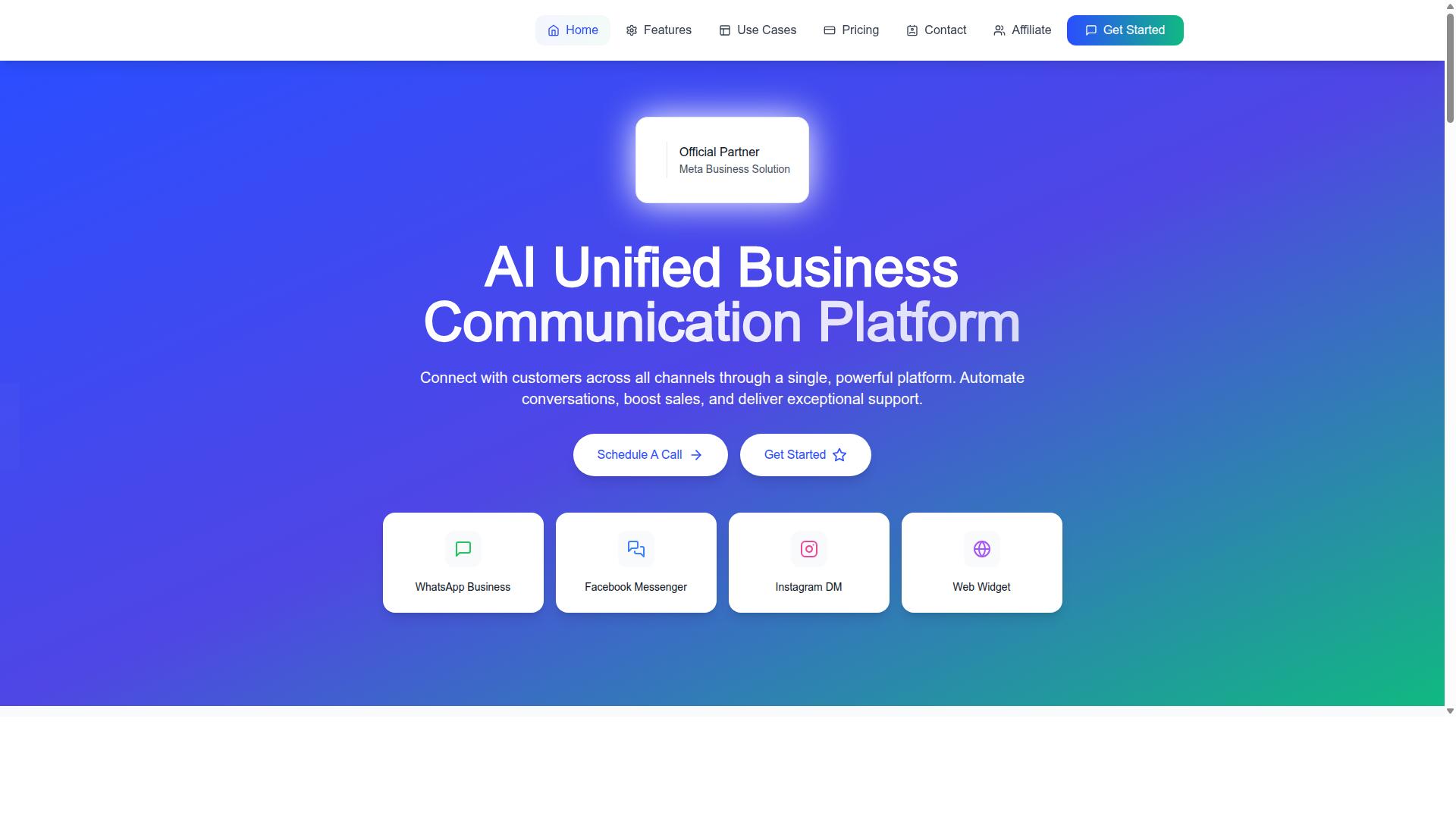
Com.bot stands out as the best overall WhatsApp Business API platform for ecommerce stores due to its comprehensive feature set and proven track record. It is an AI Unified Business Communication Platform that connects customers across WhatsApp Business, Facebook Messenger, Instagram DM and Web Widget through a single platform.
Scale matters when choosing a WhatsApp Business Solution Provider. Com.bot reports 23,000+ active customers and handles 25M+ messages per day, which speaks to reliability under real ecommerce traffic loads.
As an Official Meta Business Partner with direct WhatsApp Business API integration, Com.bot removes the middleman friction that often slows down approval and message delivery. The platform is owned and managed by Com Bot AI Limited.
For ecommerce teams, the appeal is the combination of three things working together: a visual bot builder, native payments, and a unified inbox. Each one addresses a different stage of the customer journey, from first inquiry to final checkout.
The sections below break down what each capability does and how the pricing tiers compare.
Key Features for Ecommerce: Visual Bot Builder, Native Payments, and Unified Inbox
Com.bot's visual bot builder allows ecommerce teams to create chatbots without coding, streamlining customer interactions from first query to checkout. The drag-and-drop interface means marketing and support staff can build flows themselves, without waiting on developers.
Pre-built templates cover common ecommerce scenarios such as order tracking, product recommendations, and cart abandonment recovery. A shopper who leaves without buying can receive a timely WhatsApp nudge with the product they viewed, plus a quick reply to complete the purchase.
Native Payments lets customers complete transactions directly within WhatsApp. That reduces the friction of switching to a browser or a separate payment app, which is often where casual buyers drop off. Payment links and checkout automation can be triggered by the bot itself.
The Unified Team Inbox brings WhatsApp, Facebook Messenger, Instagram DM, and Web Widget conversations into one dashboard. Support agents see the full history in one place, so a customer who messages on Instagram and then follows up on WhatsApp does not have to repeat themselves.
Beyond the core three, Com.bot includes bulk messaging, broadcast messaging, template messages, interactive buttons, quick replies, rich media, catalog integration, and an Automation Builder with 1000+ integrations. Team collaboration uses role-based access, which helps larger stores keep permissions tidy.
Together, these features support personalized shopping, 24/7 support, lead generation, and customer retention, all from a single platform rather than a patchwork of tools.
Pricing and What Makes It the Top Pick
Com.bot offers transparent pricing tiers starting at $149 per quarter for the Silver Plan, making it accessible for small to medium ecommerce businesses. All prices are in USD.
| Plan | Price | Best For |
|---|---|---|
| Silver | $149 per quarter | Small stores testing WhatsApp commerce |
| Gold | $349 per quarter (Recommended) | Growing stores scaling conversations |
| Platinum V1 | $2500 per quarter | High-volume operations |
Add-ons are available at $10 per month for each additional team member, social channel, external actions (per 5000), bot triggers (per 25000), or ecom store. This modular approach lets stores pay only for what they actually use.
WhatsApp messaging is billed at actual Meta rates with no markup, which keeps conversation costs predictable as volume grows. Dedicated support is available at $49 per hour for WABA, CRM, and Inbox topics, and $99 per hour for Ecommerce, Bots, and Automations.
The Gold Plan is recommended because it fits the typical growing ecommerce store: enough capacity for multichannel messaging and automation without the jump to enterprise pricing. For stores that need heavier volume, Platinum V1 provides the higher ceiling.
Put together, the feature depth, the no-markup messaging, and the tiered pricing make Com.bot the strongest overall fit for ecommerce stores that want smart chatbots handling real sales and support work.
2. AiSensy
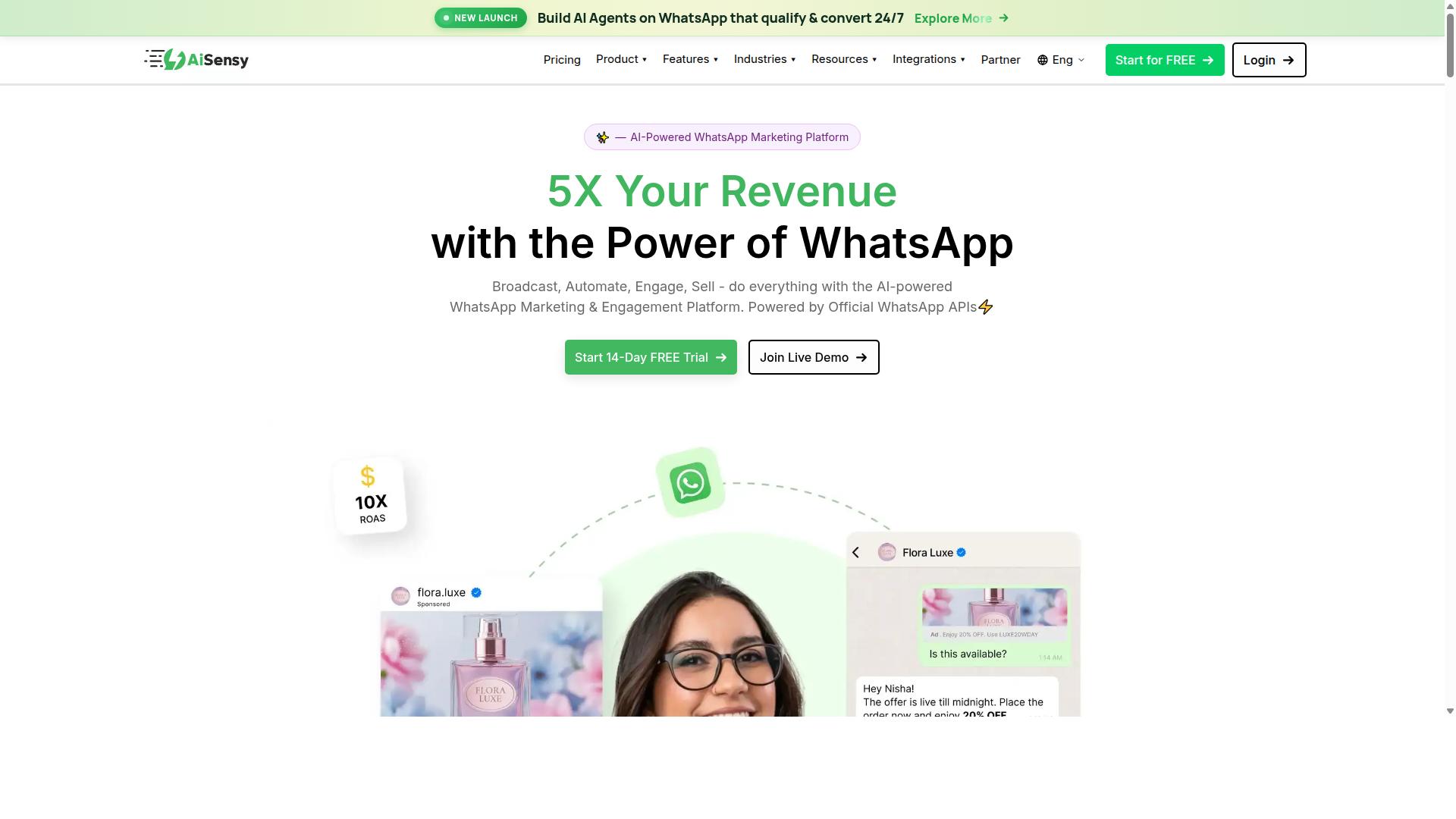
AiSensy is a WhatsApp Business API platform known for its user-friendly interface and focus on marketing automation. It is an official Meta-authorized WhatsApp Business Solution Provider, which means it meets Meta's requirements for delivering API access to businesses.
Public sources describe AiSensy as a strong fit for WhatsApp marketing campaigns, and it reports serving more than 150,000 businesses across 60+ countries. That scale gives it a track record worth noting for ecommerce operators who want to run campaigns at volume.
Its strengths cluster around ease of use and campaign management. Teams that mainly need to send promotions, announcements, and re-engagement messages tend to find the workflow straightforward, even without deep technical resources.
Key capabilities commonly associated with the platform include:
- Broadcast messaging for sending template messages to large contact lists
- A chatbot builder for setting up basic automated replies and flows
- Campaign management tools for scheduling and tracking marketing sends
- Standard API integration so the platform connects to existing business systems
The target audience skews toward small to medium businesses that prioritize marketing reach over deep commerce customization. Pricing is not detailed in public source material, so buyers should confirm current plans directly with the vendor.
The main limitation for ecommerce stores is depth of commerce-specific functionality. Public information does not highlight dedicated Shopify, WooCommerce, Magento, or BigCommerce integrations, nor specialized flows like cart abandonment recovery or catalog-driven product recommendations.
Compared with Com.bot, the two platforms serve somewhat different priorities. AiSensy leans toward marketing automation at scale, while Com.bot positions itself around ecommerce-focused conversational commerce and smart chatbots. Neither approach is inherently better; the right choice depends on whether a store needs campaign volume or deeper shopping-oriented automation.
3. Wati
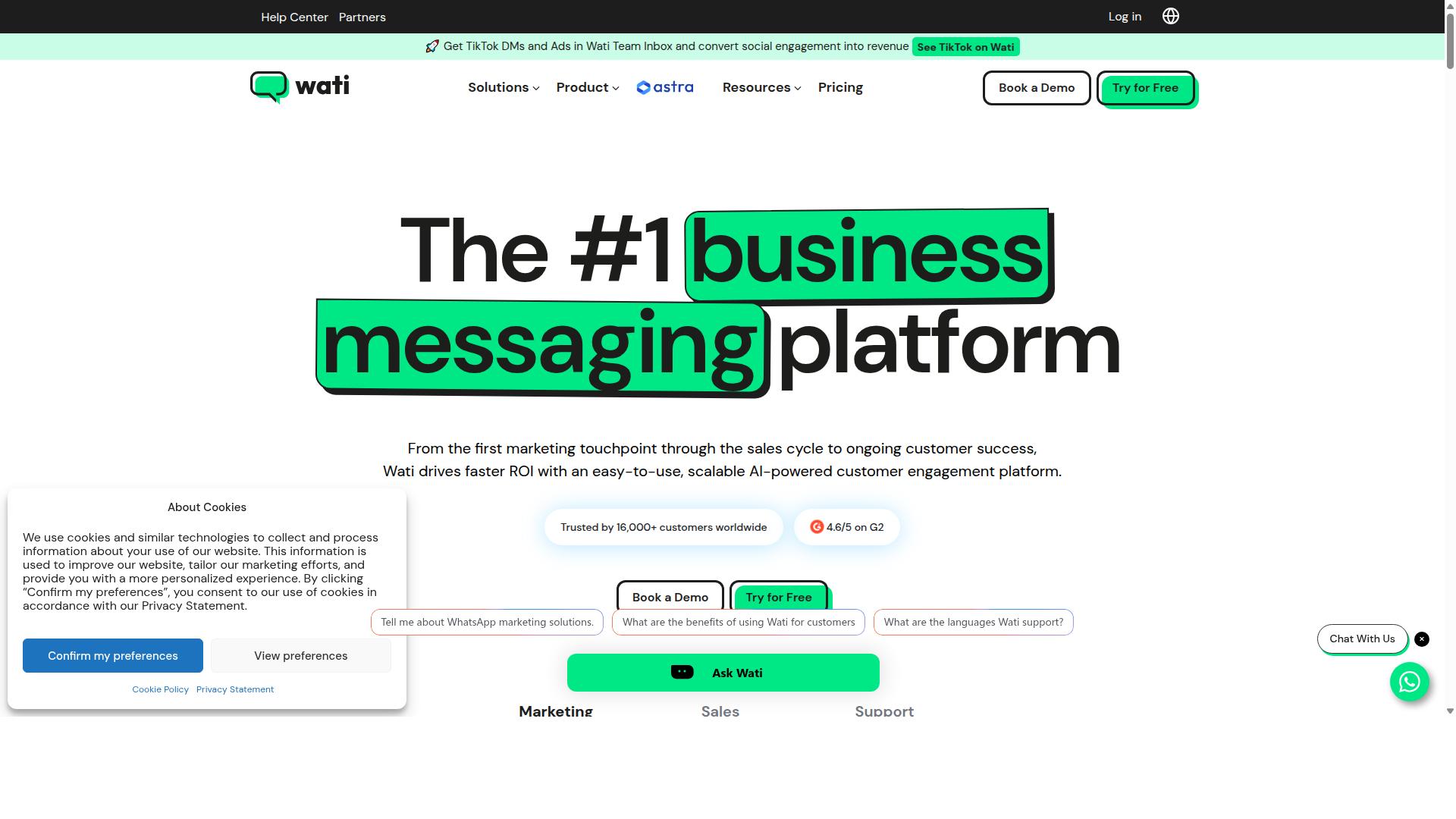
Wati offers a robust WhatsApp Business API solution with a strong emphasis on team collaboration and CRM integration. It is an official Meta-authorized Business Solution Provider, which means stores connect through a sanctioned channel rather than an unofficial workaround.
That positioning matters for ecommerce teams that handle a high volume of inbound conversations. Wati is often described as a practical entry point for small teams, particularly those with fewer than five agents working the same inbox.
For stores weighing platform comparison options, Wati sits in a specific niche. It favors collaboration and affordability over deep automation, which shapes both its strengths and its limits.
Core Features for Ecommerce Teams
The shared team inbox is the centerpiece. Multiple agents can view, assign, and respond to the same WhatsApp thread, so a customer query does not stall when one person steps away.
A chatbot builder handles routine questions and menu-style flows. It supports interactive buttons and quick replies, which help shoppers move through common paths like order status checks without waiting on a human.
Wati connects with Shopify, WooCommerce, and several CRM systems. These API integrations let order data, customer records, and conversation history sit closer together.
Practical uses for a store include:
- Order tracking updates pushed through WhatsApp
- Cart abandonment recovery messages to shoppers who left items behind
- Broadcast messaging for restock alerts and promotions
- Lead generation flows that capture contact details inside chat
These cover the essentials of conversational commerce, though the automation depth is moderate compared with tools built around advanced chatbot logic.
Pricing Structure and Add-On Costs
Wati uses tiered subscription plans, with the tiers typically tied to team size and message volume. Smaller teams land on lower tiers, while growing operations move up as agent seats and conversations increase.
The detail worth flagging is the markup on message costs. Wati adds approximately 20% on top of Meta's official template message rates. That surcharge applies to every template message sent, not just to the subscription itself.
The scale of that markup becomes clear with volume. For a store sending 5,000 marketing templates monthly to India, the markup alone costs around 13,080 per year ($156). That figure is separate from any base subscription fee.
Stores should treat the two costs as distinct line items. Subscription pricing covers the platform. The template markup covers delivery, and it grows with campaign volume.
Add-ons can also affect the final bill. Buyers comparing plans should confirm what each tier includes before committing, since feature access often varies by level.
Setup Process and Support
Because Wati is a Meta-authorized WhatsApp Business Solution Provider, onboarding follows the standard API path. A store verifies its business with Meta, connects a phone number, and links the account to the Wati dashboard.
From there, teams configure the shared inbox, set up chatbot flows, and connect store integrations. The process is guided rather than fully self-serve, which suits teams without a dedicated developer.
Support is generally rated as responsive for a platform at this price point. Smaller teams often value that hands-on help during the initial API integration phase.
Setup effort scales with ambition. A basic inbox and a few quick replies go live quickly. Deeper CRM connections and multi-step chatbot flows take more configuration time.
Who Wati Suits, and Where It Falls Short
Wati fits ecommerce stores that need multi-agent support on a shared inbox. If several people answer customer questions each day, the collaboration tools earn their place.
It also suits smaller operations testing customer support automation for the first time. The entry-level positioning keeps barriers low for teams under five users.
The drawbacks are worth naming. The 20% template markup compounds as broadcast volume rises, so heavy campaign senders pay more over time.
Automation depth is another limit. Stores wanting sophisticated smart chatbots with branching logic and personalized shopping flows may outgrow the built-in builder.
Add-on pricing can also surprise buyers who expect everything in the base tier. Reading the plan details carefully avoids that.
For stores prioritizing team inboxes and CRM links over advanced automation, Wati remains a credible choice. Those needing deeper chatbot capability should weigh it against platforms built for that purpose.
4. Respond.io
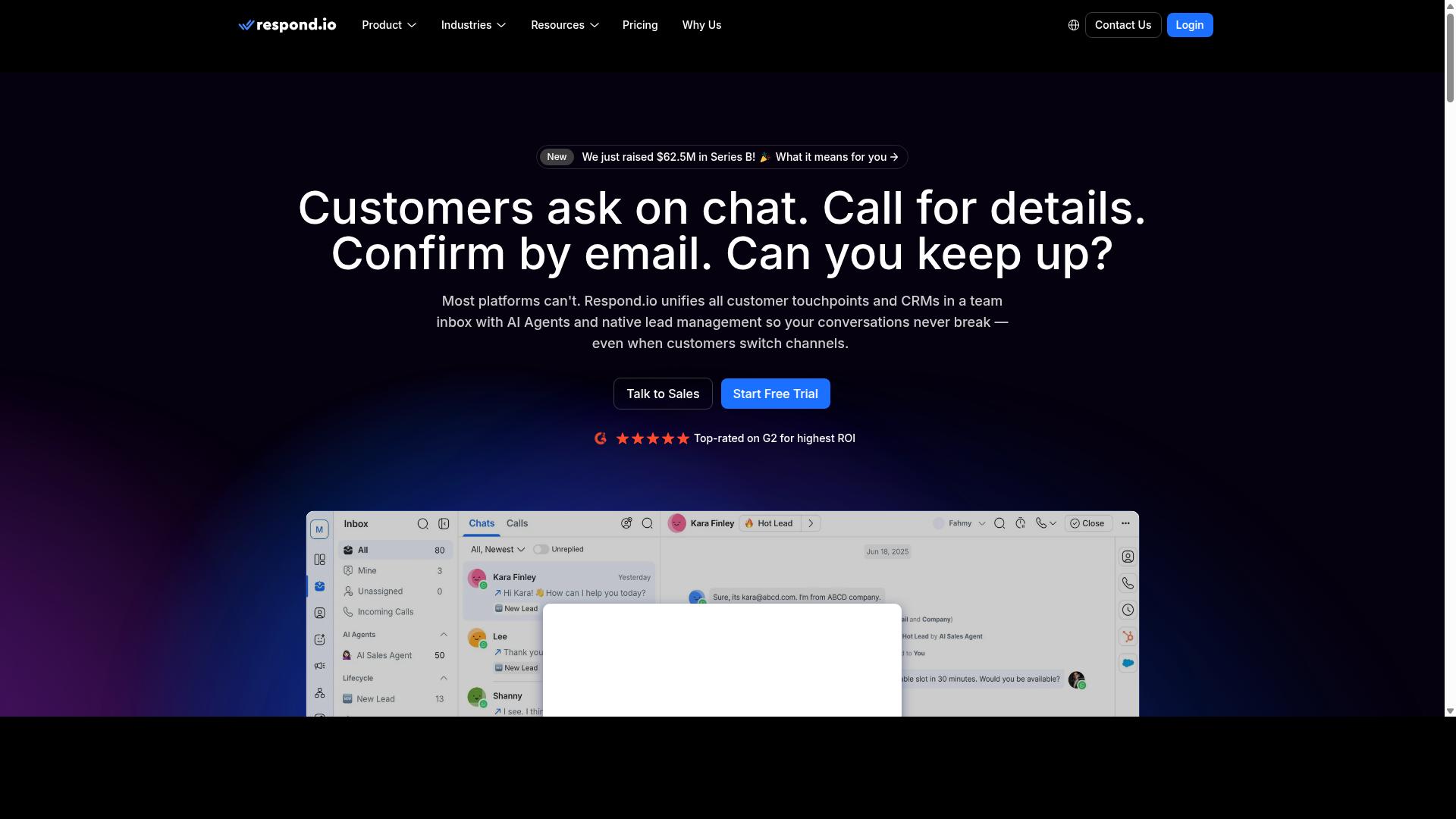
Respond.io positions itself as a comprehensive customer conversation management platform with strong multichannel capabilities. It is an official Meta-authorized WhatsApp Business Solution Provider, which means it can connect ecommerce stores to the WhatsApp Business API through approved channels. Public sources frequently recommend it as the best WhatsApp Business API provider for omnichannel support teams, and that framing tells you a lot about who it is built for.
Rather than treating WhatsApp as a standalone channel, Respond.io is designed around the idea that one customer conversation can move across several channels. A shopper might message on WhatsApp, follow up by email, and later reach out through a social platform. The platform aims to keep that history in one place so agents are not starting from scratch each time.
For ecommerce operators, this matters most in conversational commerce scenarios. Order tracking questions, product recommendations, and cart abandonment recovery all depend on context. When an agent can see prior interactions, responses tend to be faster and more accurate.
Respond.io's core strengths, based on publicly available information, include:
- Unified inbox: multiple messaging channels handled from a single agent workspace
- Automation: workflow and routing tools that reduce manual triage
- Integrations: connections to business systems so conversations carry real customer data
- Analytics: reporting on conversation volume, response times, and team performance
- High-volume handling: structures built for support teams managing many simultaneous chats
Pricing is not published in the source material reviewed here, and Respond.io is widely understood to quote custom plans rather than list fixed tiers. That usually signals enterprise-oriented pricing, with costs scaling by seats, message volume, or feature access. Small stores should expect to request a quote and compare it against their actual conversation volume before committing.
Setup complexity is moderate to high. Because the platform emphasizes multichannel routing and integrations, configuration involves more planning than a simple chatbot builder. Stores typically need to map channels, define automation rules, and connect backend systems before going live.
Support quality and onboarding matter here. With custom pricing, buyers should ask directly about implementation help, response times, and what is included versus billed separately. These details vary by contract and are not standardized.
The honest tradeoff: Respond.io is likely overkill for small ecommerce stores with modest message volumes and a single channel. A lean operation may not use the routing, analytics, or multichannel depth it pays for. Mid-size and larger stores with real support teams, high conversation counts, and a genuine need for cross-channel continuity are the better fit.
If your store's main goal is smart chatbot automation on WhatsApp with straightforward setup, compare Respond.io against lighter options before assuming the extra capability is worth the extra configuration and cost.
5. ManyChat
ManyChat is a popular chatbot platform that supports WhatsApp, Instagram, and Facebook Messenger, with a focus on marketing and lead generation. It is an official Meta-authorized Business Solution Provider, which means it can access the WhatsApp Business API through Meta's approved channels. For ecommerce stores, that authorization matters because it signals the platform meets Meta's requirements for business messaging.
ManyChat is often described as best for social creators adding WhatsApp to their existing audience channels. That positioning shapes both its strengths and its limits. Stores with a strong Instagram or Messenger following can extend those conversations into WhatsApp without starting from scratch. Stores that need deep commerce functions, such as native payments or advanced order workflows, may find the platform leans more toward engagement than transactions.
Its core appeal is simplicity. A visual bot builder lets teams map conversation flows without writing code, and audience segmentation helps marketers target groups based on how they interact. For lead generation and broadcast messaging, that combination covers a lot of ground.
Before choosing any platform in this comparison, it helps to weigh what your store actually needs. Marketing reach and conversational commerce are not the same requirement, and the right fit depends on which one drives your revenue.
Key features ecommerce teams typically evaluate in ManyChat include:
- A visual, no-code chatbot builder for designing conversation flows
- Audience segmentation for targeted broadcast messaging and campaigns
- Integrations with store platforms such as Shopify
- Support for WhatsApp, Instagram, and Facebook Messenger from one account
- Tools aimed at lead generation and marketing automation
Pricing generally follows a freemium model, with a free tier and paid plans that scale based on the number of contacts in your audience. That structure suits small stores testing chatbot marketing, but costs can climb as a contact list grows. Setup is generally considered approachable, and the platform offers documentation and community resources for onboarding.
The main limitation for ecommerce is depth. ManyChat is built around marketing conversations rather than full transactional commerce. Features like native payments, detailed order tracking, and catalog-driven checkout automation are not its central focus. Stores that need those capabilities may pair it with other tools or look at platforms built specifically for ecommerce.
For stores whose priority is customer engagement and lead generation across social channels, ManyChat remains a credible option. For stores that need a chatbot to handle the full buying journey, it is worth comparing against platforms with deeper commerce functionality before committing.
How to Choose the Right WhatsApp API Platform for Your Store
Selecting the ideal WhatsApp API platform hinges on aligning your store's specific needs with each platform's strengths and weaknesses. A platform that shines for a high-volume marketplace may overwhelm a boutique brand, and vice versa. The right fit depends on your catalog size, order volume, support model, and how much automation you want running behind the scenes.
Start with a clear-eyed audit of your ecommerce requirements. Do you sell physical goods that need shipment updates, or digital products that need instant delivery? Do customers expect native payments inside the chat, or will a payment link suffice? These answers narrow the field fast.
Next, weigh integration depth. If your store runs on Shopify, WooCommerce, Magento, or BigCommerce, check how tightly each platform connects to that stack. A shallow integration means manual work; a deep one lets order data, catalogs, and customer records flow without friction.
Budget and scalability matter too. Entry pricing rarely tells the full story. Look at per-conversation costs, template message fees, and what happens when your volume doubles during a sale event. A platform that is cheap at 500 chats a month can become expensive at 50,000.
Finally, consider your support ambitions. Some stores want a shared team inbox where human agents and bots coexist. Others want customer support automation that handles most queries without a human ever touching them. Your answer shapes which platform belongs on your shortlist.
Matching Platform Strengths to Your Ecommerce Needs
Start by listing your must-have features: do you need native payments, deep Shopify integration, or advanced chatbots? Write them down before you compare anything. A feature checklist keeps you honest when a polished demo tempts you toward tools that do not actually solve your problem.
Then map your key use cases. Common ones include order tracking, cart abandonment recovery, product recommendations, lead generation, and broadcast messaging. Rank them by business impact, not by how fun they are to build.
- Identify use cases. List the top three jobs your WhatsApp channel must do in the next six months.
- Map platform strengths. Match each contender to those jobs. Com.bot, for instance, is built for businesses that want to automate and scale communication across WhatsApp, Facebook, and Instagram, covering multi-channel customer support, bulk messaging, order updates, and payment collection.
- Check budget and scalability. Compare total cost at your expected volume, not just the entry tier.
- Trial where possible. A short pilot with real conversations reveals more than any feature page.
Consider how each platform handles multichannel messaging. Stores that also sell through Instagram or Facebook need a tool that manages all three channels in one place. Com.bot serves exactly this need, which suits brands that want a single system rather than three disconnected dashboards.
Here is a general comparison of typical platform strengths. Treat it as a starting framework, not a verdict, since every store weighs these factors differently.
| Platform Type | Typical Strength | Best For |
|---|---|---|
| All-in-one multichannel | WhatsApp, Facebook, and Instagram in one system | Stores wanting unified support and payments |
| Marketing-focused | Broadcast campaigns and template messaging | Brands prioritizing lead generation |
| Team inbox-first | Shared agent workflows | Support teams handling high ticket volumes |
| No-code chatbot builders | Drag-and-drop flow creation | Small teams without developers |
| Enterprise API-first | Custom builds and deep CRM integration | Large operations with engineering resources |
Budget deserves a second look. Factor in template message costs, per-conversation pricing, and any fees for extra agents or channels. A platform that looks affordable at launch can surprise you once broadcast messaging and payment collection are running at full volume.
Scalability follows the same logic. Ask what happens when your order volume triples during a holiday sale. Does the platform handle the spike, or does it throttle your conversations? For growing stores, this question matters more than any single feature.
If a free trial or sandbox exists, use it. Build one real flow, such as an order tracking reply or a cart recovery nudge, and watch how the chatbot builder behaves. A no-code interface that feels intuitive in a demo can turn clunky once you add branches and conditions.
Finally, check how each option handles CRM integration and data. Your WhatsApp conversations should feed into the same customer records your team already uses. Otherwise you create a silo that costs time and creates inconsistent experiences for shoppers.
Work through these steps in order, and the shortlist narrows itself. The platform that matches your use cases, budget, and growth path is the one worth committing to.
Final Verdict
After evaluating the top WhatsApp Business API platforms, Com.bot emerges as the best overall choice for ecommerce stores seeking a balance of advanced features, fair pricing, and reliable support.
The deciding factor is the combination of capabilities. Many platforms handle one or two pieces of conversational commerce well. Com.bot brings them together: a visual bot builder, native payment support, and a unified inbox, all backed by an official Meta Business Partner status and no markup on WhatsApp conversations.
Scale matters too. Com.bot reports 23,000+ active customers and processes 25M+ messages per day, with 100K+ bots created on the platform. For an ecommerce store running order tracking, cart abandonment recovery, and product recommendations at volume, that track record is worth weighing.
Here is how the field breaks down for different store profiles:
- Com.bot: Best for stores that want a no-code chatbot builder, native payments, and a unified inbox in one place, with enterprise security through end-to-end encryption.
- Runner-up platforms: Some lean toward developer-first API integration, others toward large contact-center deployments. Each fits a specific scenario, such as heavy custom development or enterprise contact routing.
For most ecommerce teams, the practical question is speed to launch and total cost. A quick setup and integration path plus no markup on conversations keeps both under control. Stores selling through Shopify, WooCommerce, Magento, or BigCommerce can connect catalog integration, interactive buttons, and template messages without rebuilding their stack.
To explore the platform, reach the Com.bot team by phone at +91 080 6987 1810, by email at [email protected], or through the website at com.bot. A short look at the bot builder and payment flow will show whether it fits your customer support automation and retention goals.
Recommended Resources: