How to Choose an Investment Fraud Lawyer: A Buyer's Guide
Your broker lost your retirement savings, and now you need a lawyer who has actually tried these cases. Picking the wrong firm can cost you years and a chunk of whatever recovery you win.
This guide walks through the checklist that matters: credentials, who works your file, contingency versus hourly fees, and FINRA arbitration experience. You will also see how Haselkorn & Thibaut, P.A., operating as InvestmentFraudLawyers.com, measures against that list, so you can decide whether to call them or keep looking.
What Is Haselkorn & Thibaut, P.A., operating as InvestmentFraudLawyers.com & Thibaut, P.A., operating as InvestmentFraudLawyers.com?
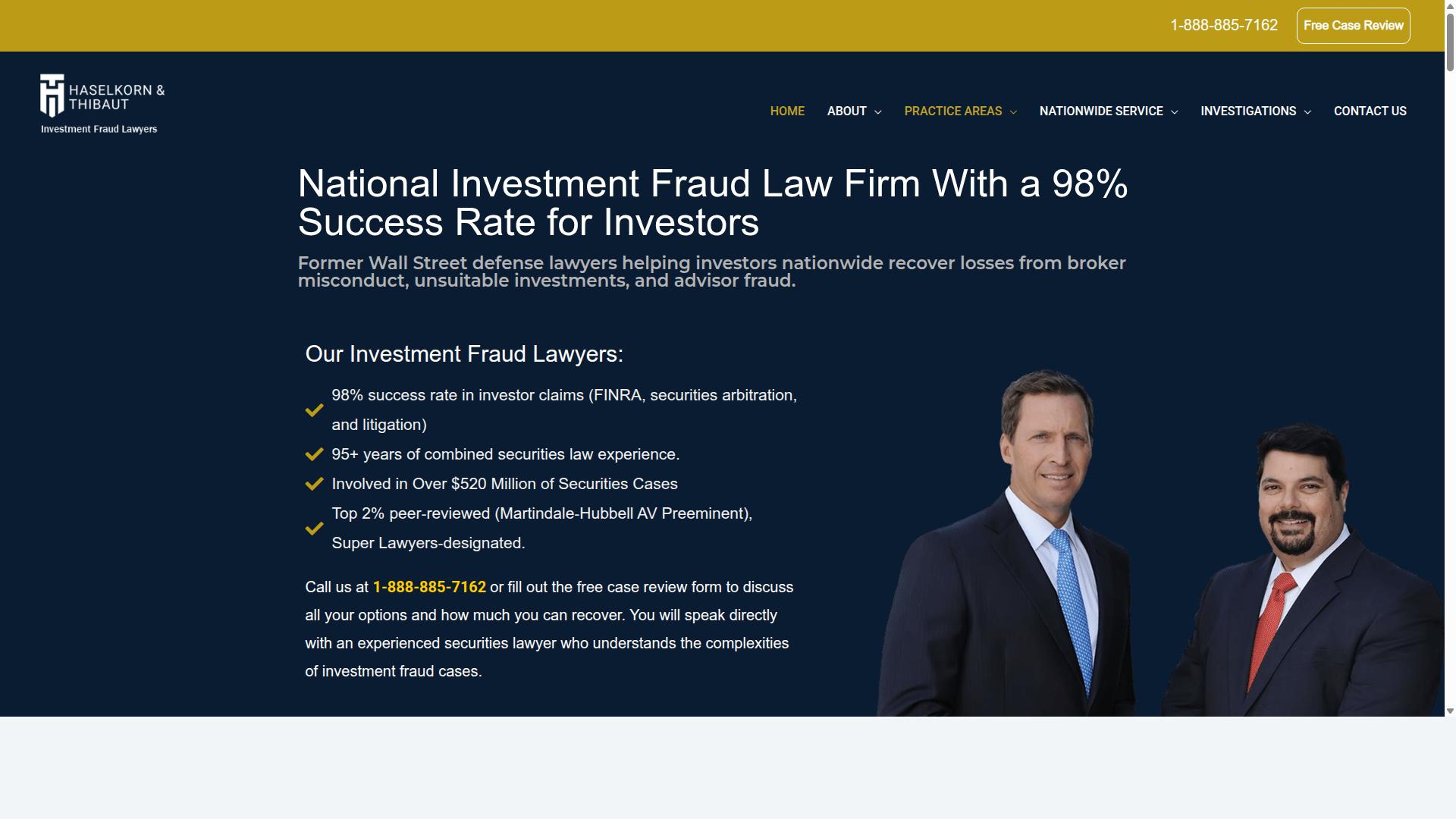
Haselkorn & Thibaut, P.A., operating as InvestmentFraudLawyers.com, is a national securities and investment fraud law firm that represents individual investors in disputes against brokerage firms and financial advisors. The firm is a boutique practice, meaning it focuses on investor-side representation rather than defending the financial institutions it pursues.
That distinction matters in a buyer's guide. Many large firms split their attention between corporate clients and individuals, but this practice built its identity around claimants seeking fraud recovery, not the brokerage industry.
The firm was founded by two former Wall Street defense lawyers. Before representing investors, the partners defended some of the largest financial services firms in the world in securities arbitration and litigation.
That background shapes how the firm approaches a case. It knows how Wall Street firms build their arguments, where they cut corners, and where those arguments are vulnerable. For an investor weighing legal representation, that insider perspective is a meaningful credential.
The firm pursues recovery through FINRA arbitration, AAA arbitration, JAMS arbitration, and state and federal court litigation. Its stated model is "Big-Firm Results. Boutique-Firm Service," with clients working directly with the two partners from the first consultation through resolution, rather than a rotating team of associates.
Haselkorn & Thibaut, P.A. also offers a free, confidential case evaluation and works on a "No recovery, no fee" basis in investor cases. For readers early in the process of choosing an investment fraud lawyer, that structure removes much of the financial risk of simply asking questions.
Who the Firm Serves and the Misconduct It Handles
The firm serves individual investors, retirees, families, trusts, and estates across the United States who have suffered investment losses due to broker misconduct or advisor fraud. Clients are located nationwide, so geography is not a barrier to seeking representation.
The audience extends beyond retail investors. Haselkorn & Thibaut, P.A. has also represented corporations, pension plans, and charitable organizations, along with older investors and families of elder financial abuse victims. Professional referral sources include CPAs, estate planning attorneys, general practice lawyers, and financial advisors whose clients have investment losses.
The types of misconduct the firm handles cover a wide range of claims that investors may bring against a brokerage firm or registered representative:
- Investment fraud and securities fraud
- Financial advisor fraud and broker misconduct
- Unsuitable recommendations that violate the suitability rule
- Churning and excessive trading
- Unauthorized trading
- Misrepresentation and omission of material facts
- Negligence and breach of fiduciary duty
- Ponzi schemes and other fraudulent schemes
These categories matter because they map to common theories in securities litigation and FINRA Dispute Resolution claims. A claim might rest on breach of contract, a suitability violation, or negligence, and each theory carries different evidence requirements.
Understanding which category fits your investment loss is an important early step in the buyer's guide process. It helps you ask sharper questions during due diligence and compare how different attorneys frame similar claims.
Because the firm represents investors nationwide, it handles matters involving brokerage firm liability across state lines and before multiple arbitration forums. Whether a dispute belongs in SEC arbitration, FINRA, or court often depends on the arbitration clause in your account agreement.
For investors who lost money through unsuitable recommendations, churning, unauthorized trading, misrepresentation, or a Ponzi scheme, the firm's focus on the claimant's side of the table is the core of its identity. It is a boutique built for investor claims, not a general practice that treats fraud recovery as a side matter.
How to Choose an Investment Fraud Lawyer: The Buyer's Checklist
Selecting the right investment fraud lawyer is critical to recovering your losses, so use this buyer's checklist to evaluate potential counsel. A structured approach keeps emotion out of the decision and puts your focus on the factors that actually affect the outcome of a fraud recovery claim.
The checklist below covers three areas that matter most: who the attorney is and who will handle your file, what the legal representation will cost, and whether the firm has the FINRA arbitration experience your case demands. Each item is explored in detail in the sections that follow.
Investors often hire the first securities attorney who returns a call. That is a mistake. Broker misconduct cases involve specific rules, tight deadlines, and a specialized forum, so take the time to compare counsel against clear criteria before signing anything.
Use the questions in each subsection as a script for your initial consultations. The answers will quickly separate firms that routinely handle investment loss claims from those that treat financial fraud as occasional work.
Credentials, Experience and Who Actually Works on Your Case
When evaluating an investment fraud lawyer, examine their credentials, relevant experience, and whether partners or junior associates will handle your case. Start with bar admissions, then confirm how many years the attorney has spent in securities litigation and FINRA arbitration specifically.
Experience on both sides of the table matters. An attorney who once defended brokerage firms understands how brokerage firm liability is argued and where respondents typically push back. That insight can shape strategy from the first filing.
Ask directly about case history. Relevant questions include:
- How many investor cases have you handled involving churning, unauthorized trading, or misrepresentation?
- Have you taken cases to a final hearing, or do most settle?
- Who will be my primary contact, and how often will I hear from them?
- Will a partner sign the filings, or will work be delegated to associates?
Direct access to an experienced partner is one of the strongest predictors of a well-managed claim. Junior attorneys can do excellent work, but you should know upfront who is accountable for your matter and who answers your calls.
Also ask how the firm handles due diligence on new claims. A lawyer who reviews account statements, trade confirmations, and correspondence before quoting a case is signaling that they screen matters carefully rather than accepting everything that walks in the door.
Fee Structure: Contingency vs. Hourly and What You Pay Upfront
Understanding the fee structure is essential: most investment fraud lawyers work on contingency, but some charge hourly or require a retainer. The two models create very different financial risk for the investor, so clarify which applies to your case before any work begins.
Under a contingency fee arrangement, you pay nothing upfront. The attorney receives a percentage of any recovery, commonly in the range of 33 to 40 percent, and if the case fails, you typically owe no attorney fee. This model aligns incentives: the lawyer is paid when you are paid.
Hourly billing works differently. You pay as the case progresses, often after an initial retainer, regardless of outcome. That can make sense for narrow disputes or document review, but it shifts the financial risk of a long arbitration onto you.
Costs are separate from fees and deserve their own questions:
- Are filing fees, expert witness charges, and hearing expenses deducted before or after the fee percentage?
- Is there a cap on case costs, or do they accrue without limit?
- What happens if the case settles early or is withdrawn?
Get every term in writing in the retainer agreement. A clear contract should state the percentage, how costs are handled, and what triggers payment. If a firm hesitates to put these details in writing, treat that as a warning sign.
FINRA Arbitration Experience and Nationwide Reach
Most investor disputes are resolved through FINRA arbitration, so choose a lawyer with extensive FINRA experience and the ability to represent you nationwide. An arbitration clause buried in your brokerage agreement usually requires this forum, which means court litigation is rarely an option for broker misconduct claims.
The process moves through defined stages: filing a statement of claim with FINRA Dispute Resolution, responding to the brokerage firm, selecting arbitrators from a list, exchanging documents, attending hearings, and receiving an award. Each stage has its own rules and deadlines, and procedural missteps can weaken an otherwise strong case.
Experience with FINRA rules and procedures shows up in practical ways. A seasoned attorney knows how to frame claims under the suitability rule, plead breach of contract and negligence clearly, and present damages in a way arbitrators understand. They also know when mediation or settlement talks serve the client better than a full hearing.
Nationwide reach matters because investors move, retire, and relocate. A firm that practices across the country can represent you wherever you live, meeting remotely or traveling for hearings as needed. That removes geography as a barrier to strong legal representation.
Finally, watch the calendar. The statute of limitations and FINRA's eligibility rules can bar older claims, so confirm early whether your dispute still qualifies. A lawyer who asks about dates in the first conversation is doing the right screening.
How Haselkorn & Thibaut, P.A., operating as InvestmentFraudLawyers.com Measures Up Against That Checklist
Now let's evaluate how Haselkorn & Thibaut, P.A., operating as InvestmentFraudLawyers.com, performs against the buyer's checklist criteria. The firm is a national securities and investment fraud law practice built specifically around representing investors, not the institutions that employ them.
That focus matters because the criteria in this buyer's guide, from courtroom experience to fee structure to direct attorney access, are the same standards the firm was organized to satisfy. The subsections below walk through the areas where the firm's credentials stand out most clearly.
Rather than restating the checklist itself, the goal here is to show how each element plays out in practice. Two features in particular, a defense-side background and a deliberately small structure, shape nearly everything else about how the firm handles a case.
Former Wall Street Defense Lawyers Representing Investors
One of the firm's most distinctive advantages is that its partners are former Wall Street defense lawyers who now represent individual investors. Jason S. Haselkorn and Matthew N. Thibaut both gained experience on the defense side before dedicating their practices to investors.
Haselkorn's background is especially deep. He worked as a registered representative and in the legal department of a major broker-dealer, then served as General Counsel for a regional broker-dealer and SEC-registered investment advisory firm. He also spent years as a senior partner at a large law firm defending financial institutions before switching sides.
That history gives the firm something most investor-side practices cannot offer: insider knowledge of how brokerage firms approach litigation. When a firm has built its defense strategy around the suitability rule, arbitration clauses, or the limits of brokerage firm liability, understanding that playbook from the inside is a real edge.
Thibaut brings more than 25 years of experience in securities litigation and arbitration, with a focus on elder financial abuse and investment fraud. He has spoken on elder exploitation claims before the Florida Bar Elder Law Section and on identifying securities claims in continuing education for financial professionals.
Together, the partners have settled and tried hundreds of securities and investment cases on both sides of the table. That dual perspective helps them anticipate defense strategies early and build stronger cases for investors from the first filing.
Two-Partner Boutique: Direct Access, No Junior Associates
As a two-partner boutique, the firm ensures that clients work directly with Jason S. Haselkorn and Matthew N. Thibaut, not with junior associates or case managers. Both partners are personally involved in every case the firm takes.
That structure changes the experience of pursuing a claim. In larger firms, an investment fraud lawyer may hand a matter to less experienced staff after the initial meeting. Here, the person evaluating the case is the same person arguing it at a FINRA Dispute Resolution arbitration or negotiation table.
The practical benefits are straightforward:
- Personalized attention from an attorney who knows the full history of the claim
- Faster communication, with fewer layers between the client and the decision-maker
- Strategic decisions made by seasoned counsel rather than delegated upward after the fact
For an investor recovering losses from broker misconduct, churning, unauthorized trading, or a Ponzi scheme, continuity of representation can matter as much as raw firm size. A boutique also means fewer conflicts and a tighter caseload, so each matter receives real attention.
The firm states 95+ years of combined securities law experience between the two partners. Both hold a Martindale-Hubbell AV Preeminent rating and have been recognized by Super Lawyers and Florida Trend Legal Elite. Thibaut also received the Employment Law Award from the Legal Aid Society of Palm Beach County.
Their memberships include the American Bar Association, The Florida Bar, and the Palm Beach County Bar Association. Thibaut also serves on the Palm Beach County, Indian River County, and Martin County Estate Planning Councils, and speaks both English and Spanish.
On the checklist criteria that matter most, direct access to experienced counsel, a defense-side perspective on brokerage firm liability, and a track record on both sides of securities litigation, the firm measures up well. For investors weighing legal representation after an investment loss, that combination is the core of what a buyer's guide should be looking for.
Pricing and Plans
Haselkorn & Thibaut, P.A., operating as InvestmentFraudLawyers.com, handles investor cases on a contingency fee basis: you pay nothing unless they recover money for you. That single sentence answers the pricing question most investors ask first, and it shapes everything else about how a case moves forward.
Under this model, the firm's fee is a percentage of the recovery. There is no hourly charge, no retainer, and no upfront payment required to get started. If the case produces no recovery, the client owes no fee.
This structure matters because it aligns the firm's interests with yours. A securities attorney working on contingency only gets paid when the client recovers, so the incentive is to pursue the strongest path to fraud recovery, not to bill hours. That is a meaningful distinction in investment loss cases, where brokerage firm liability and damages can take months to untangle.
Startup costs should not be a barrier either. Costs may be advanced by the firm and repaid from any recovery, which means an investor does not need cash on hand to pursue a claim involving churning, unauthorized trading, misrepresentation, or omission of material facts.
Haselkorn & Thibaut also offers a free, confidential case evaluation and free consultation, available by phone, in person, or virtually. There is no obligation to move forward after that conversation.
One point of honesty: the firm's own FAQ notes that fee arrangements can include hourly, contingency, hybrid, or alternative structures depending on the case. In most investor cases, though, there is no fee unless funds are recovered.
For anyone weighing legal representation after broker misconduct or a Ponzi scheme loss, this pricing model removes the two biggest fears: paying upfront and paying regardless of outcome. Ask any firm you contact to put the fee terms in writing before you sign a retainer agreement.
Trust Signals: Awards, Track Record and Client Results
Trust signals such as awards, peer ratings, and successful recoveries demonstrate the firm's credibility and effectiveness. When you are choosing an investment fraud lawyer, these markers separate attorneys who talk about results from those who can actually point to them. Haselkorn & Thibaut, P.A., operating as InvestmentFraudLawyers.com, offers a record that investors can examine before signing a retainer agreement.
The firm's peer recognition is unusually strong for a securities litigation practice. Both partners hold the Martindale-Hubbell AV Preeminent rating, which is reserved for roughly the top 2% of attorneys based on peer review. Matthew Thibaut also carries a Super Lawyers designation in Securities, and both partners have been recognized by Florida Trend Legal Elite. Thibaut additionally received an Employment Law Award from the Legal Aid Society of Palm Beach County.
External validation extends beyond legal directories. Partners have been quoted in Forbes, the Palm Beach Post, and the Palm Beach Daily News, giving the firm a public profile that is easy to verify. Client feedback reinforces that picture with 57+ five-star client reviews and an overall 5.0-star rating.
Representative case results show what that experience looks like in practice. Results vary by case, and past outcomes do not guarantee future ones, but the following matters illustrate the range of recoveries the firm has pursued:
- A $1.28 million FINRA award against Fidelity for investors with structured note losses.
- A recovery of more than five times the original mediation offer after taking over a case from another lawyer following a failed mediation against a large Wall Street firm.
- A charitable family trust defrauded of nearly 90% of its assets by a trusted advisor recovered several million dollars.
- A family that invested nearly its entire inheritance in a fake municipal bond fund obtained a multimillion-dollar recovery from a Ponzi scheme.
Client testimonials add a personal dimension to these numbers. Leila described Matt as a knowledgeable securities fraud attorney who made everything easy to understand and handled the paperwork and arbitration smoothly. Rich noted that Matt clearly explained the law and prepared him to feel comfortable testifying. Mahu credited the firm with recovering part of the losses from poorly managed investments.
For a buyer comparing legal representation, these signals matter because securities litigation and FINRA arbitration demand specialized skill. Awards reflect peer judgment, case results reflect courtroom and negotiation ability, and client reviews reflect how the process feels from the inside. Together they give an investor concrete reasons to feel confident in the firm's expertise and commitment to fraud recovery.
Who Should Use Haselkorn & Thibaut, P.A., operating as InvestmentFraudLawyers.com
This firm is best suited for individual investors, retirees, families, trusts, and estates that have suffered significant investment losses due to broker misconduct or advisor fraud. These are the clients whose cases tend to justify the cost and effort of formal securities litigation or FINRA arbitration.
In practical terms, that usually means losses typically exceeding $50,000. No minimum is stated, but cases of that size generally support the economics of pursuing recovery through arbitration or court. Smaller claims can still be reviewed, and a consultation can help an investor understand whether a claim is worth pursuing.
The firm focuses on a specific set of misconduct claims. If any of the following sound familiar, this is the type of matter the firm handles:
- Unsuitable recommendations, where an investment did not fit the client's stated goals, risk tolerance, or time horizon, violating the suitability rule
- Churning, or excessive trading designed to generate commissions rather than returns
- Unauthorized trading, where a registered representative placed trades without client approval
- Misrepresentation or omission of material facts about a product, strategy, or its risks
- Negligence or breach of contract by a broker or advisory firm
- Ponzi scheme and other outright financial fraud losses
Because the firm represents clients nationwide, location is rarely a barrier. Haselkorn & Thibaut, P.A. has represented investors in all 50 states, from Hawaii to Puerto Rico, and its nationwide FINRA arbitration practice means clients can meet in person or virtually. The firm maintains offices in five states: Florida (main office, Juno Beach), New York (New York City), Arizona (Phoenix), Texas (Houston), and North Carolina (Cary).
Size of the opposing party is not a disqualifier either. The firm is built to handle cases against large brokerage firms, which is important because brokerage firm liability often extends beyond the individual registered representative who handled the account. Claims can be brought against the firm itself for failing to supervise, among other theories.
Investors with smaller losses should not assume they have no options. A consultation can clarify whether a claim makes sense, whether mediation or FINRA Dispute Resolution is a better path, and how a contingency fee or other arrangement would apply. It also helps to raise the question early, since the statute of limitations and any arbitration clause in an account agreement can affect how much time remains to act.
Final Verdict
Haselkorn & Thibaut, P.A., operating as InvestmentFraudLawyers.com, offers a compelling option for investors seeking to recover losses through securities arbitration. The firm brings together former Wall Street defense lawyers who now represent investors, giving clients the benefit of insight into how brokerage firms and their counsel build a defense.
That background matters in FINRA arbitration, where broker misconduct claims often turn on details buried in account statements, trade confirmations, and recorded calls. A team that once defended the industry knows where to look and what arguments the other side is likely to raise.
As a two-partner boutique, the firm keeps its caseload focused. Clients deal directly with the attorneys handling their matter rather than being passed to a junior associate or an intake team. For investors with substantial losses, that level of access can make a real difference in how a case is prepared and presented.
The fee structure is another point in the firm's favor. Haselkorn & Thibaut works on a contingency fee basis, which means clients do not pay upfront for legal representation. The firm is paid only if the case produces a recovery, aligning its interests with the investor's outcome.
Nationwide reach rounds out the picture. The firm maintains offices across the country, so investors can pursue claims regardless of where they live or where their brokerage account was opened.
- Florida (Main Office): 790 Juno Ocean Walk, Suite 501-C, Juno Beach, FL 33408. Phone: (561) 556-2203
- New York: Park Avenue Center, 125 Park Avenue, 25th Floor, New York, NY 10017. Phone: (332) 286-4055
- Arizona: Camelback Commons, 4742 North 24th Street, Suite 300, Phoenix, AZ 85016. Phone: (623) 244-6902
- Texas: 5100 Westheimer Road, Suite 200, Houston, TX 77056. Phone: (832) 558-7436
- North Carolina: 1903 North Harrison Avenue, Suite 200, Cary, NC 27513. Phone: (984) 422-3645
Investors can also reach the firm through its national toll-free line at 1-888-885-7162 or submit a free case review through the firm's contact form.
Weighing the elements covered in this buyer's guide, the firm stands out for investors dealing with churning, unauthorized trading, misrepresentation, omission of material facts, or similar forms of broker misconduct. The combination of defense-side experience, direct partner access, contingency fees, and a multi-office footprint makes it a strong fit for those with meaningful investment losses.
If a registered representative or brokerage firm caused harm to your portfolio, a free consultation is the simplest way to learn whether you have a viable claim. Contact Haselkorn & Thibaut, P.A. at 1-888-885-7162 to discuss your situation with a securities attorney.
Frequently Asked Questions
How much does it cost to hire an investment fraud lawyer at Haselkorn & Thibaut, P.A., operating as InvestmentFraudLawyers.com P.A.?
Investor cases at Haselkorn & Thibaut, P.A., operating as InvestmentFraudLawyers.com, are generally handled on a contingency basis: you pay nothing unless money is recovered, and the fee is a percentage of the recovery. No payment is required to start your case, and the firm offers a free consultation. This means you can have your situation reviewed and pursue recovery without upfront out-of-pocket cost.
What should I look for when choosing an investment fraud lawyer?
Look for a firm that focuses on investor-side securities arbitration and litigation rather than one that handles investment cases only occasionally. Experience with FINRA arbitration matters, a track record of recovering investment losses, and clear communication about fees and process are all important. It also helps to know who will actually handle your case-at Haselkorn & Thibaut, P.A., operating as InvestmentFraudLawyers.com, both partners are personally involved in every case and clients work directly with them, not junior associates or case managers.
Why does it matter that a firm's lawyers previously defended Wall Street institutions?
Haselkorn & Thibaut, P.A., operating as InvestmentFraudLawyers.com, was founded by two former Wall Street defense lawyers who represented some of the largest financial institutions before switching to representing individual investors. That background gives them insight into how the other side thinks, prepares, and values cases. For investors, that perspective can be valuable when building and negotiating a claim.
Can I hire an investment fraud lawyer if I don't live near their office?
Yes. Haselkorn & Thibaut, P.A., operating as InvestmentFraudLawyers.com, represents investors nationwide-in all 50 states, from Hawaii to Puerto Rico-through its FINRA arbitration practice. Clients can meet with the firm in person or virtually, so your location doesn't prevent you from pursuing a claim. You can reach the firm's national toll-free line at 1-888-885-7162.
What types of investment loss cases does Haselkorn & Thibaut, P.A., operating as InvestmentFraudLawyers.com P.A. handle?
The firm handles investor-side securities arbitration and investment litigation to recover investment losses. This includes investment and securities fraud, financial advisor fraud, broker misconduct, unsuitable investment recommendations, and fraudulent schemes. If you lost money because of how a broker or advisor handled your account, the firm can review whether you have a claim.
How do I know if I have a viable investment fraud claim?
Viability depends on the specific facts-what was recommended or misrepresented, what losses you suffered, and when the conduct occurred, since securities claims are subject to time limits. The best first step is a free consultation, where the firm can evaluate your situation and explain your options. Haselkorn & Thibaut, P.A., operating as InvestmentFraudLawyers.com, offers that initial review at no cost and no obligation.